
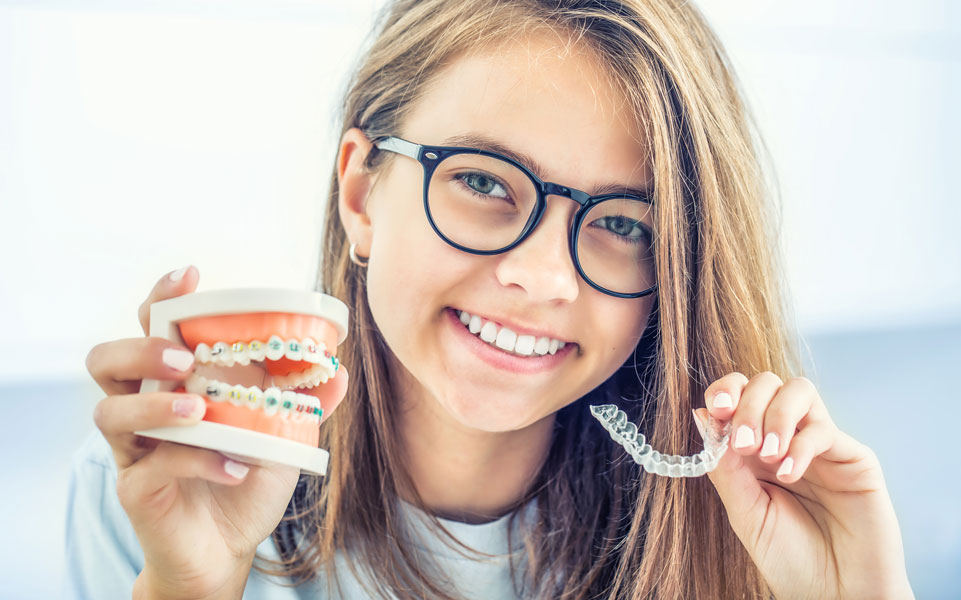
At Aberdeen Orthodontics, our Specialist Orthodontists tailor every plan. Below, you will find a simple, honest comparison to help you decide with confidence.
A quick overview of your options
- Invisalign® aligners: Clear, removable trays that straighten teeth when worn 20 to 22 hours per day. Great for day-to-day discretion and flexibility.
- Ceramic braces: Tooth-coloured brackets and clear wires for a subtler look than metal, with the same predictable mechanics.
- Metal braces: The classic fixed option - strong, efficient, and suitable for all levels of complexity.
All three can be excellent. The right option for you comes down to priorities such as visibility, comfort, discipline with wear, and how complex your bite is.
Is Invisalign® faster than braces?
Sometimes, yes, but not always. Treatment speed is mainly driven by case complexity and how closely you follow the plan. With Invisalign®, you must wear aligners 20 to 22 hours daily. If you do, many mild to moderate cases complete in roughly 6 to 18 months. Fixed braces move teeth around the clock without relying on wear discipline, which can be an advantage for some patients.
At our clinic, we also use Dental Monitoring via a smartphone app. You send weekly photos, and our team checks your progress remotely. This can reduce in-clinic visits and, if you are ahead of schedule, may allow safe progression to your next aligner sooner. The same close oversight benefits fixed-brace patients too.
Are clear braces better than Invisalign®?
It depends what you mean by better. Ceramic braces are fixed to your teeth, so you do not remove them to eat or clean. This is helpful if you prefer not to think about wear time. They also use the same proven mechanics as metal braces, which is reassuring for complex movements.
Invisalign® aligners are more discreet from a conversational distance and removable for meals, photos, or music rehearsals. They make oral hygiene simpler because you can brush and floss normally. If you know you will wear them as directed, Invisalign® can be just as effective for many cases, including complex ones, when planned by a Specialist Orthodontist using attachments, precision cuts and elastics where needed.
The better choice is the one you can live with every day. If you value flexibility and near invisibility, Invisalign® is hard to beat. If you want set-and-forget predictability without managing wear time, ceramic braces might suit you.
Comfort, speech, and eating
Comfort: Most patients feel mild pressure when starting treatment or changing an aligner or wire. Aligners are smooth and usually kind on cheeks and lips. Ceramic and metal braces can rub at first, though orthodontic wax helps.
Speech: Aligners may slightly affect speech for a day or two while you adapt. Braces rarely affect speech beyond the first week of settling.
Eating: With Invisalign® you remove aligners to eat, so there are no food restrictions. With braces, avoid hard or sticky foods to protect brackets and wires.
What is the cheapest invisible option in the UK?
If by invisible you mean aligners, low headline prices often exclude essential parts of care such as refinements, attachments, elastics, retainers, and in-person specialist oversight. At Aberdeen Orthodontics, quotes are bespoke after assessment, and they include the appropriate clinical steps to reach your goal. Private fixed options can be more affordable upfront, especially metal braces, though ceramic braces and Invisalign® remain popular for their aesthetics.
If you are comparing, look for what is included, not just the sticker price. Our Treatment Coordinators can walk you through finance choices and typical ranges for braces Aberdeen prices, with zero deposit and interest-free options for eligible plans.
Is ClearCorrect as good as Invisalign®?
Clear aligner brands share similarities, but Invisalign® has a long history of research, materials development, and sophisticated software planning. Our clinicians are Invisalign Diamond Providers, which reflects extensive experience with the system across mild and complex cases. That experience matters. The skill of your Specialist Orthodontist and the precision of your plan will influence your result more than a brand name alone. In our practice, we use Invisalign® because of its predictability, smart features, and proven outcomes in our hands.
Is it worth getting clear braces?
If you want fixed-appliance accuracy with a lower profile than metal, yes. Ceramic braces blend with your teeth, and for client-facing roles or big life events, that can make day-to-day life easier. They deliver the same tooth movement as metal braces and suit a wide range of cases. The trade-offs are similar care instructions as metal braces and a little more attention to cleaning around brackets.
What is the best age to get invisible braces?
There is no single best age. Orthodontics is effective for teens and adults, and we tailor timing to your dental development and goals.
- Children: Some benefit from early assessments around age 7 to monitor growth and plan ahead.
- Teens: Once most adult teeth have erupted, Invisalign® Teen or fixed braces are excellent choices. Wear indicators and features like mandibular advancement can be used where needed.
- Adults: It is never too late to straighten teeth. Healthy gums and bone support are the key requirements. We have many patients choosing invisible braces Aberdeen to fit work and family life.
Lifestyle fit and daily routine
- Discipline: Invisalign® needs consistent wear. If you think you might forget to reinsert aligners after meals, fixed braces remove that risk.
- Visibility: Invisalign® is very discreet. Ceramic braces are subtle but still visible up close. Metal braces are visible and can be a fun, bold choice for teens.
- Appointments: With Dental Monitoring, we can space visits and keep closer virtual tabs on progress, which helps busy professionals, offshore workers, and families.
How to decide what is right for you
- Book a specialist assessment: We take iTero 3D scans, photos, and x-rays where needed, then discuss your goals and timeline.
- See your options: You will get a clear, written plan with costs, inclusions, and finance choices.
- Compare honest trade-offs: We will explain how each option affects comfort, appearance, care, and speed.
If you are an adult exploring treatment, you may find our page on adult braces helpful for next steps and finance guidance. Prefer aligners and a fully digital journey with remote check-ins? Read more about Dental Monitoring and how this pairs beautifully with Invisalign®.
Summary: Invisalign® vs braces, which should you choose?
- Invisalign® is ideal if you want near-invisible treatment, easy cleaning, and flexibility, and you are confident you will wear aligners 20 to 22 hours per day.
- Ceramic braces suit you if you want discreet fixed treatment with the predictable mechanics of braces.
- Metal braces are robust, efficient, and cost-effective - and they handle every level of complexity.
There is no one-size-fits-all answer. The best choice is the one that fits your lifestyle and achieves your goals safely. At our purpose-designed clinic on George Street, Aberdeen, our Specialist Orthodontists will help you compare options and choose with confidence.
Ready to explore what would work best for you? Get in touch with our friendly team to learn more about how a specialist-led, digital approach could fit your life.
Back Aberdeen Orthodontics


 Open in Google Maps